Stone of Centuries: How Jade Carries Financial Worth and Family Memory Through Every Generation
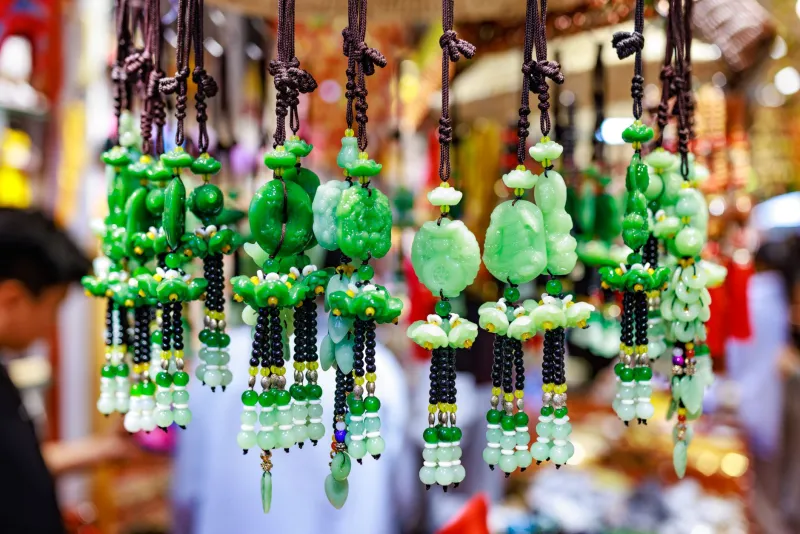
There is a particular kind of wealth that cannot be measured in market indices or appraised in a single afternoon. It accumulates slowly, passing through hands that have held it in joy and in grief, in celebration and in quiet ordinary moments. Jade understands this kind of wealth instinctively. It is, perhaps, the only luxury material that operates simultaneously as a financial instrument and a living record of the people who have loved it.
For collectors and families across the United States who have stewarded fine jade pieces across multiple generations, the stone represents something that contemporary luxury—with its seasonal rotations and trend-driven valuations—rarely offers: permanence with a pulse.
What Estate Specialists Know That Most Buyers Don't
Amanda Forsythe, a senior specialist in Asian decorative arts and estate jewelry based in New York, has spent over two decades evaluating jade collections as they move between generations. Her perspective is unambiguous.
"When a family brings me a piece of imperial-grade jadeite that was purchased in the 1970s or 1980s, the appreciation we document is consistently remarkable," she explains. "But what is equally remarkable is the difficulty families have in parting with it. That emotional resistance is itself a form of value. It tells you something profound about what jade does to the people who own it."
Forsythe notes that high-quality jadeite—particularly pieces with deep emerald translucency, uniform saturation, and fine carving provenance—has outperformed many traditional luxury categories over thirty-year horizons. Unlike fashion jewelry, which depreciates the moment it leaves a boutique, or even certain colored gemstones whose valuations fluctuate with mining output, top-tier jade occupies a more stable stratum. Supply from Myanmar's finest deposits has not grown meaningfully in decades, while global appetite—particularly among American collectors who have discovered the stone relatively recently—continues its steady climb.
The Tangible Asset Argument
Financial advisors who specialize in alternative and tangible assets have begun paying closer attention to jade's position within diversified portfolios. Marcus Ellington, a wealth manager based in San Francisco whose clientele includes several prominent collectors of Asian art, frames jade's appeal in straightforward terms.
"My clients who hold significant jade pieces are not holding them in lieu of equities," he clarifies. "They hold them because tangible assets of genuine rarity behave differently during periods of market volatility. Fine jade, like museum-quality art or exceptional colored diamonds, tends to be insulated from the kind of liquidity-driven selling that hammers paper assets. You cannot create more imperial jadeite. That scarcity is structural."
Ellington is careful to distinguish between investment-grade jade—pieces of documented provenance, exceptional material quality, and skilled artisanship—and the broader jade market, which, like any collectible category, contains wide variation. The heirloom equation, he emphasizes, only holds when the original acquisition is made with discernment. "Families who inherit meaningful value are almost always families where someone, at some point, bought very well."
A Living Archive in Green and White
Beyond the financial calculus lies something harder to quantify but no less real. The Whitmore family of Charleston, South Carolina, has held a collection of Chinese nephrite carvings and a set of jadeite bangles for four generations. The pieces were originally acquired by Eleanor Whitmore, a diplomat's wife who lived in Hong Kong during the 1950s and developed a deep appreciation for Cantonese jade culture.
Her granddaughter, Catherine Whitmore-Park, now in her early forties, describes the experience of inheriting these pieces as something closer to receiving a correspondence than a bequest.
"Each piece came with a story," she recalls. "My grandmother wrote notes—not formal appraisals, but personal accounts. This bangle was worn to a particular dinner. This carving sat on a desk during a period of professional difficulty. When I hold them, I am not just holding jade. I am holding her experience of life."
This phenomenon—what some collectors and curators have taken to calling the stone's narrative accumulation—is not incidental to jade's value. It is, in many respects, its defining characteristic among heirloom materials. A diamond solitaire can be reset, recut, and effectively erased of its history. Jade, particularly carved jade with its unique surface character and irreproducible form, resists that erasure. Its story is written into its shape.
Why Jade Outlasts Trends
The luxury market is not always kind to its own creations. Fashion jewelry, even pieces that carry prestigious signatures, often struggles to retain relevance across generational shifts in taste. What reads as sophisticated in one decade can appear dated in the next, and monetary value follows aesthetic relevance downward.
Jade sidesteps this cycle with unusual grace. Its appeal is not rooted in a particular stylistic moment but in qualities—translucency, depth of color, the cool weight of the stone, its ancient cultural resonance—that exist outside of trend entirely. American collectors who might otherwise feel uncertain about the longevity of a luxury purchase find in jade a material that has been considered precious across five thousand years of human civilization. That is a track record no contemporary design house can replicate.
Forsythe observes this dynamic regularly in her estate work. "I have never had a client tell me that their grandmother's jade felt old-fashioned. That simply does not happen. What I hear, consistently, is that the piece feels timeless—and that they want to keep it."
Acquiring With Intention
For those considering jade as a foundational piece in a family collection—something to be worn now and passed forward deliberately—the guidance from specialists is consistent: prioritize material quality above all else, seek documented provenance where possible, and work with jewelers and dealers who can speak knowledgeably about the stone's origins and treatment history.
Untreated jadeite of high color and translucency commands a significant premium, and for good reason. It is this category of stone that holds its financial value most reliably and that carries the greatest aesthetic authority across decades. A piece acquired with this level of care does not merely enter a family's possession—it enters a family's story.
The heirloom equation, ultimately, is not complicated. It asks only that the buyer think not in seasons but in generations. Jade, patient and enduring as the earth from which it came, is already prepared to do its part.
Green's Jade celebrates the rare intersection of natural artistry and enduring value. Each stone we present is selected with the understanding that it may one day be the most meaningful object in someone's inheritance.