Hands That Speak in Stone: Inside the Ateliers of America's Finest Jade Carvers
Hands That Speak in Stone: Inside the Ateliers of America's Finest Jade Carvers
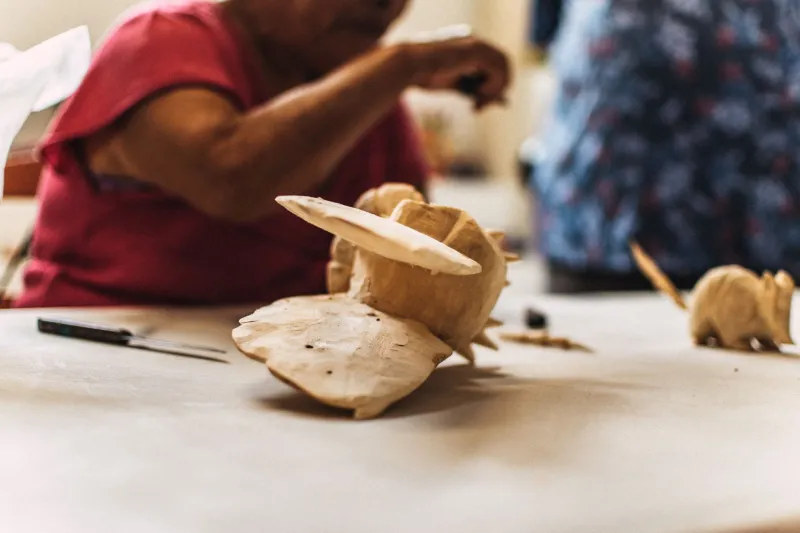
There is a particular silence that settles over a jade carver's studio. It is not the silence of emptiness, but of concentration — the kind that accumulates over decades of learning to read a stone the way a surgeon reads a patient. Water drips steadily onto rotating burrs. Fine dust, pale as chalk, drifts through shafts of afternoon light. And somewhere within a rough, unassuming boulder of nephrite or jadeite, a form waits to be discovered.
In the United States, the number of carvers who work jade at the highest level can be counted without removing your shoes. They are not celebrities. They do not maintain social media presences calibrated for virality. What they possess instead is something rarer: an almost unreasonable intimacy with one of the world's most demanding natural materials, and a client list that reads like a roster of serious collectors who have long since moved past the decorative and into the genuinely profound.
Why Jade Resists the Impatient
Before meeting the carvers themselves, it is worth understanding why jade demands so much of the people who work it. Unlike softer stones that yield readily to chisels and abrasives, both nephrite and jadeite rank among the toughest minerals on earth — not merely hard, but fibrous and interlocked at the crystalline level in a way that makes them extraordinarily resistant to fracture. This same quality is what made jade the material of choice for ancient Mesoamerican ceremonial objects and Chinese imperial court regalia. It is also what makes a careless cut catastrophic.
"You cannot force jade," explains one California-based carver who trained first as a lapidary and spent years studying classical Chinese carving techniques before developing his own vocabulary. "The stone tells you where it wants to go. Your job is to listen carefully enough to hear it." His studio, tucked into a converted warehouse outside of Santa Fe, is a study in organized patience: shelves of raw material sorted by provenance and color temperature, reference photographs of Han dynasty burial suits pinned beside botanical drawings, and a workbench worn smooth by years of use.
Three Studios, Three Philosophies
The Naturalist: Form Drawn From the Stone's Own Landscape
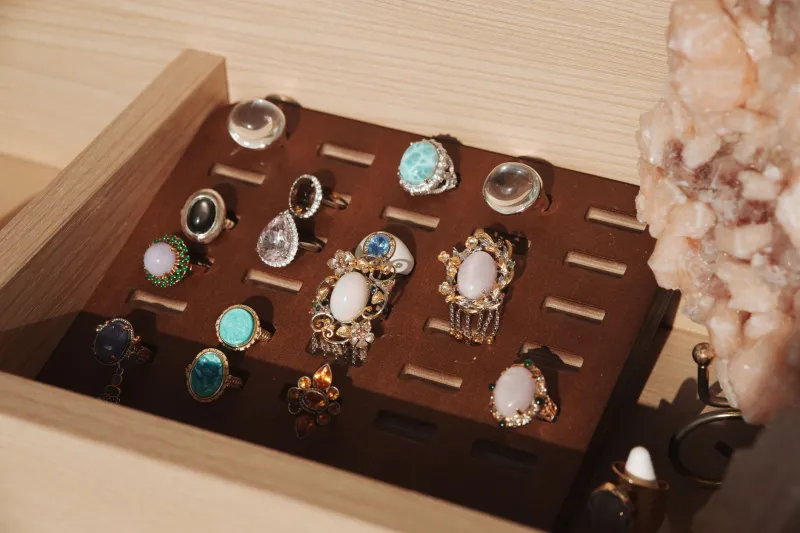
Among the carvers working in jade today, few have attracted the attention of serious jewelry collectors quite like a New Mexico-based artist who came to the craft through a background in fine art sculpture. Her pieces — pendants, brooches, and wearable objects that blur the line between jewelry and miniature sculpture — are characterized by an almost geological fidelity to the stone's natural inclusions and color shifts. Where another carver might treat a dark vein of iron oxide as an imperfection to be avoided, she incorporates it as compositional element, allowing the stone's own biography to shape the finished form.
Collectors who commission her work frequently wait eighteen months or longer for delivery. The price of a single pendant can exceed that of a comparable piece set with fine diamonds, a fact she discusses without apology. "When you commission a carved jade piece, you are not buying a product," she says. "You are investing in a conversation between your intention and the stone's nature, mediated by someone who has spent twenty years learning how to translate."
Her clientele tends toward collectors who already own significant works on paper or canvas — people accustomed to thinking about acquisition in terms of decades rather than seasons.
The Classicist: Ancient Techniques, Contemporary Sensibility
A second carver, based in the Pacific Northwest, arrived at jade through an unlikely route: a graduate degree in East Asian art history, followed by an apprenticeship with a Taiwanese master carver who had himself trained in the imperial tradition. His work is immediately recognizable for its technical precision — surface finishes so refined they appear almost liquid, and openwork carving so delicate that the finished piece seems to defy the very toughness of its material.
His studio maintains a reference library of museum catalogs and auction records, and he speaks about jade with the vocabulary of a scholar as readily as that of a craftsman. "The great Qing dynasty carvers understood that the value of the finished piece was inseparable from the value of the process," he observes. "Every decision — where to place a motif, how deeply to undercut a relief, which surfaces to polish and which to leave matte — was a considered one. That is the tradition I am working within."
For American collectors new to jade at this level, he recommends beginning with a consultation rather than a commission, taking time to handle different grades of material and understand what distinguishes imperial-grade jadeite from fine nephrite before committing to a piece.
The Innovator: Where Geology Meets Wearability
The third carver profiled here operates from a studio in Colorado and represents a younger generation that has absorbed classical training while refusing to be constrained by it. Her work pairs carved jade elements with fine metalwork — platinum settings, hand-fabricated gold bezels — in ways that speak directly to the American luxury jewelry market without sacrificing the integrity of the stone. A recent commission involved a carved jadeite centerpiece set within a collar of hand-formed platinum wire, intended to be worn at the kind of charity galas and institutional dinners that populate the social calendars of her clients.
"My clients are sophisticated," she says. "They know their Hermès from their Bottega. They are not looking for something that reads as ethnic artifact or costume piece. They want something that holds its own on a table where the conversation is as likely to be about contemporary art as it is about fashion."
How to Identify — and Commission — Truly Artisanal Work
For collectors considering a first commission, several markers distinguish genuine artisanal jade carving from the mass-produced pieces that flood the lower end of the market.
First, provenance of material matters enormously. Ask where the rough stone originated and whether the carver selected it personally. Serious carvers maintain relationships with trusted rough dealers and often travel to source material themselves.
Second, examine the quality of surface finishing under magnification. Machine-cut jade typically shows uniform scratching patterns; hand-worked pieces exhibit the subtle irregularities of human decision-making, particularly in transitions between polished and matte areas.
Third, expect a conversation, not a catalog. The finest carvers do not offer a menu of available designs. They begin with your intentions, your aesthetic references, and the stone itself, and proceed from there.
Finally, understand that the waiting list is not an inconvenience — it is a signal. The carvers whose work holds and appreciates in value are precisely those who cannot be rushed.
The Case for Jade as a Long-Term Holding
Among investment-minded collectors, carved jade by a named American artisan occupies an interesting position. Unlike mass-market jewelry, which depreciates the moment it leaves the retailer, a documented commission from a carver with an established exhibition and auction record can appreciate meaningfully over time — particularly as the pool of working masters remains so constrained.
The secondary market for exceptional carved jade has strengthened considerably over the past decade, driven in part by increased interest from American collectors who previously focused on European fine jewelry. Auction houses have taken note. Several pieces by the carvers profiled here have exceeded their high estimates at regional sales, and at least one has appeared at a major New York house.
The ancient Chinese understood jade as a material that improved with handling — that the warmth of the human body and the oils of the skin brought out qualities invisible in the rough. There is a metaphor in that for the collector willing to think in the long term: the best jade pieces do not simply hold their value. Over time, in the right hands, they deepen.