Pale Violet, Profound Value: The Collector's Case for Lavender Jadeite
Pale Violet, Profound Value: The Collector's Case for Lavender Jadeite
There is a particular kind of knowledge that circulates quietly among serious collectors — the kind that never makes it onto a billboard or into a department store display case. It travels instead through private viewings, dealer correspondence, and the unhurried conversations that happen after auction previews, when the catalogues have been set aside and the real talk begins. Lavender jadeite occupies exactly that register. For years, it has been the stone that connoisseurs mention in careful tones, as though speaking too loudly might disturb something fragile and rare. That reticence, it turns out, was never entirely misplaced.
What the Color Actually Is — and Why It Is So Difficult to Find
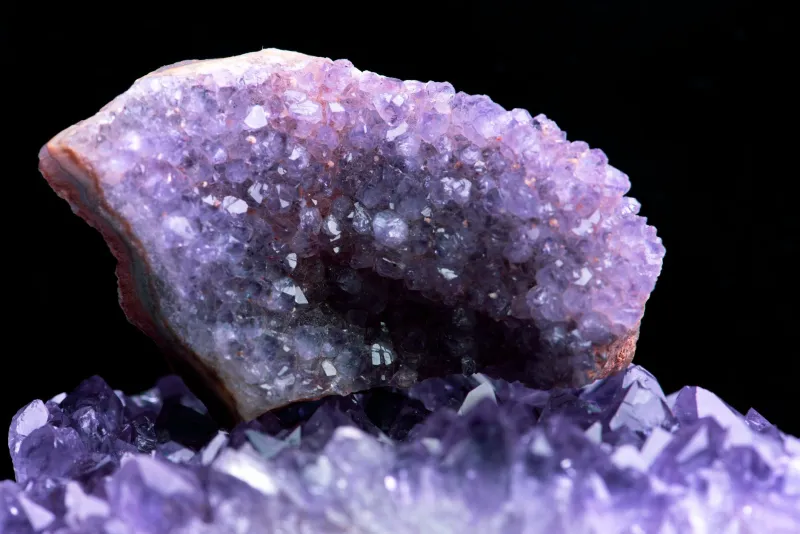
To appreciate lavender jadeite, one must first understand what produces its distinctive hue. Unlike the chromium that saturates imperial green jadeite with its vivid, saturated tone, lavender's coloration is attributed primarily to the presence of manganese ions within the stone's interlocking crystalline structure. The result is a color that exists somewhere between lilac and soft periwinkle — cool, luminous, and almost impossible to replicate artificially without detection by modern gemological instruments.
What makes this scientifically interesting also makes it commercially significant: the geological conditions required to produce lavender jadeite at gem quality are exceptionally specific. The stone forms within high-pressure metamorphic environments, and the precise concentration of manganese needed to yield a desirable violet tone — neither too washed out nor too saturated — occurs with far less frequency than the conditions that produce green material. Gem-quality lavender jadeite of meaningful size and even color distribution is, by any honest geological accounting, rarer than its green counterpart.
Gemologists at leading laboratories, including those affiliated with the Gemological Institute of America, have noted that lavender material presents particular challenges in grading because the color is highly sensitive to lighting conditions. Under daylight-equivalent illumination, a fine lavender stone can appear almost otherworldly in its translucency. Under incandescent light, the same stone may shift subtly toward gray. This optical complexity, far from diminishing the stone's appeal, has become part of its fascination for collectors who appreciate nuance over simplicity.
The Symbolism That Travels Across Traditions
In Chinese cultural tradition — from which so much of the Western world's jade literacy is borrowed — lavender jade carries associations with nobility, spiritual clarity, and feminine refinement. It has historically been connected to the concept of inner cultivation, the idea that one's character, like a fine stone, is shaped by pressure and time rather than surface polish alone. For collectors with roots in Chinese heritage, owning a fine lavender piece is not merely an aesthetic decision; it is a statement about values that transcend the transactional.
Yet lavender jadeite's symbolism does not belong exclusively to one tradition. In the broader Western context, violet and lavender have long carried connotations of wisdom, contemplative depth, and quiet authority. The Victorians associated pale violet gems with spiritual sensitivity and intellectual refinement — qualities that map surprisingly well onto the sensibilities of today's American collector who has grown weary of the merely ostentatious. In a market where loud luxury has begun to feel exhausted, the understated dignity of lavender jadeite reads as genuinely sophisticated rather than performatively modest.
Early Champions: The Dealers and Collectors Who Saw It First
Among those paying close attention to lavender jadeite's trajectory are a small but influential cohort of American dealers who began prioritizing the color well before it attracted mainstream auction attention. Jewelers working in cities such as San Francisco, New York, and Honolulu — metropolitan centers with deep connections to jade-literate communities — have reported a measurable shift in client inquiries over the past several years. Collectors who once asked first and exclusively for green material are now arriving with questions specifically about lavender, often after encountering a single exceptional piece that recalibrated their understanding of what jade could be.
Private collectors who entered the lavender market early describe a similar awakening. One New York-based collector, who began acquiring jade seriously in the mid-2010s, recalls purchasing a lavender jadeite bangle at a West Coast auction for a price that, by her own admission, reflected the market's comparative indifference to the color at the time. That same piece, she notes, would attract substantially more competitive bidding today. Her experience is not unique. Dealers who specialize in fine jadeite have observed that lavender material from reputable sources, accompanied by credible laboratory certification and clear provenance, is achieving prices that would have seemed optimistic five years ago.
What the Auction Record Is Beginning to Suggest
The major international auction houses — whose Hong Kong and New York sales remain the primary price-discovery mechanism for fine jadeite — have begun presenting lavender material with greater curatorial prominence. Pieces that might once have been offered as secondary lots are appearing in headline positions, accompanied by scholarly catalogue notes that frame the color's rarity in explicit terms. This is not accidental. Specialist departments at these institutions are acutely sensitive to collector appetite, and the signal they are sending about lavender jadeite is worth reading carefully.
It would be premature to suggest that lavender has displaced imperial green in terms of absolute price per carat at the very highest levels of the market. It has not, and it may not for some time. What it has done, however, is compress the gap in ways that few anticipated. More importantly, lavender jadeite is attracting a category of buyer who is less interested in following an established hierarchy and more interested in acquiring something genuinely scarce before that scarcity is universally acknowledged. In collecting, as in most endeavors, the most advantageous position is the one occupied slightly ahead of consensus.
Wearing Lavender: The Aesthetic Dimension
Beyond the investment argument lies something equally compelling: lavender jadeite is, by almost any aesthetic measure, extraordinarily beautiful to wear. Its cool violet tones complement a remarkably wide range of skin tones and sit with particular elegance against neutral and monochromatic wardrobes — the precise palette that dominates American luxury dressing at this moment. A finely carved lavender jadeite pendant or a translucent bangle worn against a cream or charcoal sleeve achieves the kind of visual precision that no synthetic material can approximate.
Jewelers who work extensively with lavender material note that its color rewards settings in white gold and platinum, which allow the stone's cool undertones to read clearly without competition. Rose gold, by contrast, can create an interesting tension — warming the stone in ways that some collectors find appealing and others find dissonant. As with all fine jade, the setting conversation is ultimately personal, but it is a conversation worth having with a jeweler who knows the material intimately.
The Collector's Moment
Lavender jadeite sits at an unusual intersection: rare enough to be genuinely scarce, beautiful enough to be worn with conviction, and symbolically rich enough to carry meaning across generations. For the American collector who has moved beyond the introductory chapter of jade literacy, it represents exactly the kind of discovery that defines a serious collection — one built not on what everyone already values, but on what the most attentive eyes recognized first. The language of lavender, it turns out, is spoken fluently only by those willing to listen before the room grows loud.