Knowing the Stone: Why Distinguishing Jadeite from Nephrite Is the First Rule of Serious Jade Collecting
In the auction rooms of New York and the private galleries of Beverly Hills, a quiet but consequential drama unfolds with regularity. A piece described simply as "jade" changes hands for a sum that bears little relation to its true market value. Sometimes the price is far too high. Occasionally, it is a remarkable bargain. In nearly every case, the determining factor is the same: whether the buyer understood precisely what they were purchasing.
The word "jade" has long functioned as a kind of elegant shorthand, collapsing two mineralogically distinct stones — jadeite and nephrite — into a single, romantically loaded term. For the casual admirer, this ambiguity is largely harmless. For the collector investing tens or hundreds of thousands of dollars, it is a vulnerability that the market will exploit without hesitation.
Two Minerals, One Name, an Enormous Price Difference
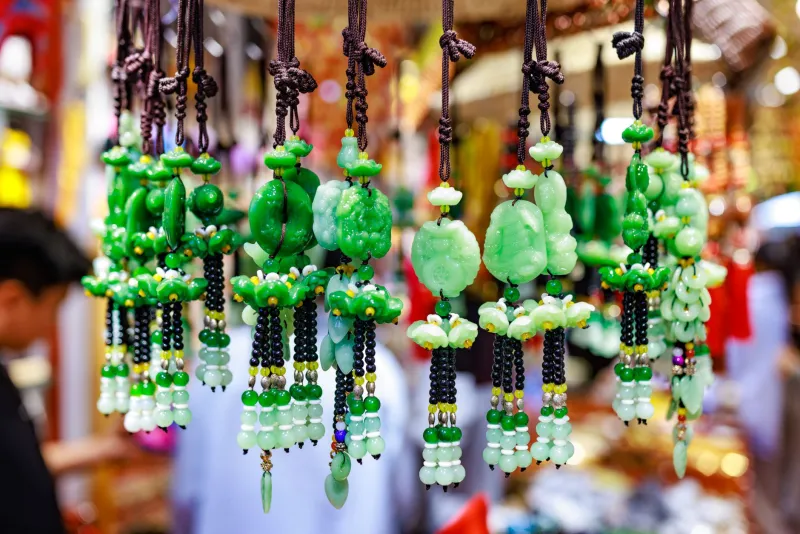
Jadeite and nephrite share certain visual qualities — a waxy luster, a range of green tones, an ancient cultural resonance — but they are, in every meaningful geological sense, separate materials. Jadeite is a sodium aluminum silicate, formed under conditions of high pressure and relatively low temperature, and found in only a handful of locations worldwide. Myanmar, known historically as Burma, produces the finest specimens, and the best of these — the translucent, intensely saturated material known as Imperial Green — commands prices that rival the most exceptional colored diamonds.
Nephrite, by contrast, is a calcium magnesium iron silicate, more widely distributed across the globe, and generally less rare in its finest forms. British Columbia, Wyoming, and New Zealand all produce nephrite of varying quality. While exceptional nephrite carries genuine value and a distinguished collecting history in its own right, it does not approach the price ceiling of top-tier jadeite. The distinction matters enormously at the point of sale.
At major American auction houses, lots described with imprecise language — "jade bangle," "carved jade pendant," "antique jade figure" — routinely attract bidders operating on assumption rather than knowledge. When a nephrite piece is mistaken for jadeite, the consequences cut both ways: an uninformed buyer overpays, while an uninformed seller may unknowingly part with a superior stone at a fraction of its worth.
The Market's Tolerance for Imitation
The confusion is compounded by the prevalence of jade simulants and treated material circulating within the broader marketplace. Glass, serpentine, aventurine, and dyed quartzite have all, at various points, been presented to American consumers as jade — sometimes through deliberate misrepresentation, sometimes through simple ignorance within the supply chain.
Within the jade trade, treated jadeite is classified under a tiered system. Type A jade is untreated, its color and translucency entirely natural. Type B has been chemically bleached and polymer-impregnated to improve its appearance. Type C has been artificially dyed. The differences are not always apparent to the naked eye, yet they translate into price differentials of staggering magnitude. A Type A Imperial jadeite bangle of fine quality might sell at auction for six figures. A visually similar Type B piece, properly disclosed, might fetch a small fraction of that sum.
For the American collector accustomed to the relatively transparent grading systems applied to diamonds — where standardized reports from the Gemological Institute of America have long provided a common language — the jade market can feel disorienting. There is no single universally adopted grading scale for jade. The criteria are more nuanced, the expertise more specialized, and the documentation, historically, less consistent.
How Informed Collectors Are Closing the Gap
The response among serious American collectors has been deliberate and methodical. Gemological certification from respected institutions has become a non-negotiable prerequisite for significant purchases. Laboratories including the GIA, the Gübelin Gem Lab, and the American Gemological Laboratories offer jade identification and treatment-disclosure reports that provide an authoritative baseline. For any piece of consequence, demanding such documentation before completing a transaction is now considered elementary due diligence.
Beyond certification, a growing cohort of collectors is investing in direct education. Specialist dealers — those who have built their reputations specifically within the jade and colored stone market — offer an irreplaceable form of mentorship. Spending time in the company of such professionals, handling stones across a range of quality grades, develops the kind of tactile and visual literacy that no certificate alone can confer. The weight of a fine jadeite bangle, the particular depth of color in an untreated stone held to natural light, the subtle surface characteristics that distinguish genuine material from its imitators — these are lessons learned through sustained, hands-on engagement.
Auction previews, too, have become a favored classroom for the dedicated collector. The major houses — Christie's, Sotheby's, Bonhams — provide preview periods precisely so that prospective bidders may examine lots in person. A collector who attends these events consistently, who asks questions of specialists and compares pieces across sessions, accumulates a working knowledge that translates directly into better purchasing decisions.
The Collector Who Knows Is the Collector Who Wins
There is a particular form of confidence that belongs to the collector who has done the work. It is not the confidence of the casual buyer who trusts a seller's description without inquiry, nor the false assurance of someone who has paid a premium for a piece without understanding its qualities. It is the quiet authority of someone who can look at a stone, consider its characteristics alongside its documentation, and arrive at an independent, well-reasoned judgment.
In the current American market, where interest in jade as both a cultural artifact and a financial asset continues to expand, this informed posture has become something of a status marker in itself. Among serious collectors, the ability to speak precisely about material origin, treatment history, and gemological classification signals a level of commitment that commands respect — and, not incidentally, tends to produce superior long-term returns.
The collectors acquiring the most significant pieces today are not necessarily those with the largest budgets. They are, more often, those who have invested the time to understand what they are buying. They know that "jade" is not a single thing. They know what Imperial Green means, and why it matters. They know to ask for the laboratory report, to seek out the specialist dealer, to handle the stone themselves before committing.
A Foundation Worth Building
For those entering the jade market — or deepening an existing engagement with it — the foundational lesson is straightforward: precision of knowledge protects and amplifies the value of every acquisition. The collector who understands the difference between jadeite and nephrite, who can read a gemological report with comprehension, and who has cultivated relationships with reputable specialists, is the collector positioned to acquire with genuine confidence.
At Green's Jade, we hold that the most enduring luxury is not merely the stone itself, but the understanding one brings to it. Rare materials reward those who take the time to know them well.