Shaped by Hand, Defined by Vision: The Lapidary Art That Determines What Jade Becomes
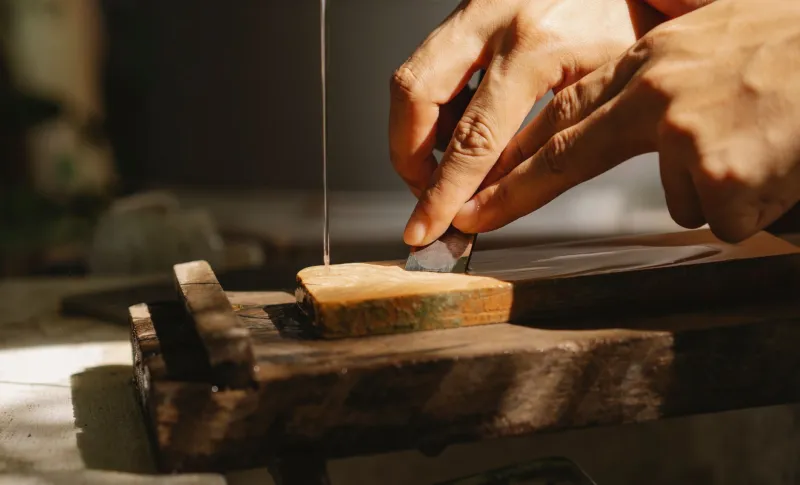
There is a moment in the life of every jade stone when its destiny is decided. It is not the moment it emerges from the earth, nor the moment it is set in platinum and placed beneath gallery lighting. It is the moment a master lapidary takes it in hand, studies its interior geography, and begins to work. That decision — how to orient the stone, which form to pursue, how aggressively to reveal or protect what lies within — is, in many respects, the most consequential act in the entire journey from mine to mantelpiece.
And yet, among American collectors, the lapidary's contribution remains one of the least examined variables in jade acquisition. Color receives devoted attention. Translucency is debated at length. Provenance commands premium prices. But the cut — the physical transformation of raw mineral into wearable form — is often accepted without scrutiny, as though it arrived fully realized from nature itself. It did not. It arrived from a craftsperson's judgment, skill, and vision. Understanding that distinction separates the informed collector from everyone else.
What a Lapidary Actually Does
The word "lapidary" derives from the Latin lapis, meaning stone, and the discipline encompasses every technique by which a rough gemstone is shaped, polished, and prepared for use in jewelry or decorative objects. In the context of jade — a stone with properties unlike any other — lapidary work demands a particular combination of geological literacy and artistic intuition.
Jade, whether jadeite or nephrite, is a fibrous, interlocking mineral structure of exceptional toughness. It does not cleave predictably the way diamonds do, nor does it fracture along obvious planes. A lapidary working with jade must read the stone's internal grain, anticipate how it will respond to the grinding wheel, and make dozens of micro-decisions along the way. The removal of even a millimeter of material is permanent. There is no going back.
The primary forms a lapidary might choose include the cabochon, the carved relief, the freeform, and the intaglio — each carrying distinct implications for how light travels through the stone, how the finished piece wears on the body, and ultimately, what it will command at auction or in private sale.
The Cabochon: Discipline in Its Purest Form
The domed cabochon remains the most prevalent form in fine jade jewelry, and for good reason. Its smooth, convex surface allows translucency to assert itself fully, drawing the eye into the stone's interior and revealing the quality of its color saturation and clarity. But a cabochon is far more demanding than it appears.
A poorly executed cabochon will be immediately apparent to a trained eye: the dome may be asymmetrical, the girdle uneven, or the base improperly flattened, causing the stone to rock in its setting. More critically, an inexperienced lapidary may orient the stone incorrectly, placing its finest color concentration off-center or failing to account for how the dome's curvature will distribute that color when viewed from above.
Master lapidaries who specialize in jade develop an almost intuitive sense of orientation. They hold the rough stone against a light source, rotating it slowly, identifying the precise axis along which the color appears most vivid and most evenly distributed. That axis becomes the stone's new vertical. Everything else follows from that single decision.
Carved Relief and Intaglio: Where Lapidary Becomes Sculpture
Beyond the cabochon lies a category of lapidary work that approaches fine art: the carved jade piece, whether in low relief, high relief, or the recessed technique known as intaglio. These forms have deep roots in both Chinese and Mesoamerican jade traditions, and they are experiencing a genuine renaissance among American collectors who seek pieces with narrative and tactile complexity.
Carved jade demands not only technical mastery but compositional intelligence. The lapidary must determine how a motif — a dragon, a floral spray, a geometric abstraction — will interact with the stone's natural color variations. In fine jadeite, a skilled carver may deliberately route a design so that a vein of emerald green traces the body of a carved fish, or so that a pale lavender inclusion becomes the petal of a carved flower. This is not accident. It is choreography.
Intaglio work, in which the design is cut into the surface rather than raised from it, creates a shadow-play of depth that rewards close examination. Several American craftspeople working today have revived this technique, applying it to jade in ways that merge classical European gem-engraving traditions with the stone's distinctly Eastern heritage.
America's Quiet Masters
The number of lapidaries in the United States who possess genuine mastery of jade cutting is remarkably small — perhaps a few dozen individuals who have devoted years, sometimes decades, to understanding this singular stone. Many trained under older craftspeople who themselves learned from Asian or European traditions. Some are self-taught, having developed their skills through obsessive study and an accumulated library of mistakes.
Several operate from studios in the American Southwest, particularly in New Mexico and Arizona, where a strong regional tradition of lapidary work intersects with a collector community that has long valued fine stones. Others are based in New York and Los Angeles, working in close collaboration with the fine jewelry designers and private clients who seek their services.
What distinguishes these craftspeople is not simply technical facility but editorial restraint. The finest lapidaries know when to stop. They understand that jade, unlike most gemstones, rewards a certain deference — that the stone often has more to say than the cutter, and that the highest form of lapidary skill is knowing how to listen.
What Collectors Should Examine
For anyone acquiring a significant jade piece, the following lapidary considerations merit careful attention before any purchase is finalized.
Symmetry and proportion. In a cabochon, the dome should be consistently curved when viewed from multiple angles. Any flattening or irregularity suggests rushed or unskilled work.
Color orientation. The most saturated and evenly distributed color should be positioned to be seen directly when the piece is worn or displayed. If the finest color is visible only from an oblique angle, the stone was likely oriented for yield rather than beauty.
Polish quality. Fine jade should carry a vitreous, glass-like polish across its entire surface. Scratches, micro-pitting, or dull patches indicate insufficient finishing and will diminish both appearance and long-term value.
Edge integrity. In carved pieces, edges should be clean and consistent. Ragged transitions between carved elements suggest the use of mechanical shortcuts rather than hand-finishing.
Proportional weight. A well-cut jade piece should feel substantial for its size, indicating that material was not sacrificed unnecessarily to achieve a particular shape.
The Cut as an Investment Variable
In the auction market, lapidary quality is increasingly acknowledged as a meaningful price determinant. A stone of moderate color but exceptional cut may outperform a finer stone that has been carelessly shaped, because experienced bidders understand that the lapidary's work is irreversible. A beautifully cut jade cannot be improved. A poorly cut one cannot be corrected without significant material loss.
For collectors building a serious collection, this has a practical implication: acquiring pieces with documented lapidary provenance — knowing who cut the stone, when, and under what circumstances — adds a layer of value that will compound over time, much as knowledge of a painting's conservation history enhances its market position.
The stone speaks, always. But it speaks in the language the lapidary taught it. Choosing a jade piece without considering the quality of that teaching is, in the end, choosing to hear only half the story.