Stone as Decor: The Interior Designers Bringing Jade Into America's Finest Living Spaces
Stone as Decor: The Interior Designers Bringing Jade Into America's Finest Living Spaces
There is a moment, familiar to anyone who has held a well-carved piece of nephrite or jadeite, when the stone seems to hold warmth rather than simply reflect it. That quality — intimate, almost animate — is precisely what has drawn a new generation of American interior designers toward jade as a decorative medium. No longer confined to the display cabinets of serious collectors or the cultural institutions that house ancient Chinese imperial wares, jade objects are now appearing on lacquered consoles in Bel Air, on custom shelving in Manhattan penthouses, and beside reflecting pools in the private courtyards of Palm Beach estates.
The shift is neither accidental nor merely aesthetic. It speaks to a broader recalibration of what luxury means in the American home.
Why Jade, Why Now
For decades, the dominant language of high-end American interiors was one of imported marble, bespoke metalwork, and rare hardwoods. These remain coveted materials. But a growing number of design professionals report that their clients — many of them seasoned collectors with considerable international exposure — are actively seeking objects that carry narrative weight alongside visual beauty.
Jade delivers both in abundance. Its geological formation spans millions of years. Its cultural biography extends across ancient Mesoamerican civilizations, Maori communities in New Zealand, and the courts of dynastic China. When a piece of well-sourced nephrite or fine jadeite enters a room, it arrives with an invisible archive that no factory-produced accent piece can replicate.
Designers also point to the stone's extraordinary range as a practical advantage. Jade is not a single color or texture. It encompasses everything from near-translucent imperial green to milky celadon, from deep spinach tones to warm lavender-gray. A designer working with a neutral, bone-toned interior will find jade's subtler hues — pale grey-green nephrite, for instance — as accommodating as any natural linen. Those building richer, more jewel-toned rooms discover that high-quality jadeite can anchor a palette with a depth that painted surfaces simply cannot match.
The Entry Hall: First Impressions in Stone
Among the designers Green's Jade has spoken with, the entry hall or foyer emerges repeatedly as the preferred location for a client's inaugural jade acquisition. The logic is sound. An entry space sets the emotional register of an entire home. It is where guests form their first impression and where residents make a daily transition between the outside world and private life.
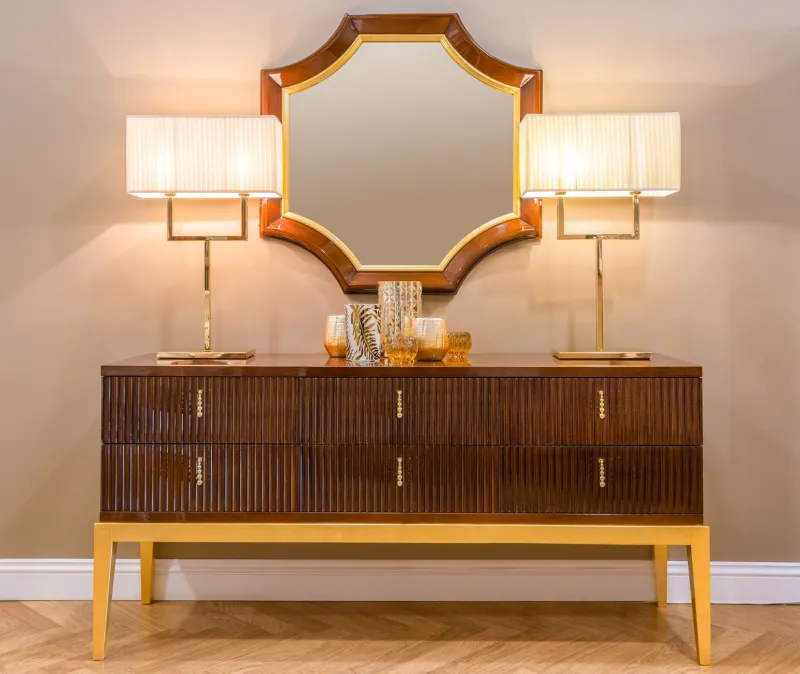
A substantial jade bowl — perhaps thirty centimeters across, carved from a single piece of pale nephrite and placed on a stone or lacquered console — accomplishes several things simultaneously. It introduces natural material at eye level. It invites touch. And it signals, without ostentation, that the inhabitants of this home have a particular relationship with beauty that goes beyond the merely fashionable.
Some designers favor sculptural forms for entry placements: a carved jade ruyi scepter mounted on a custom acrylic stand, or a contemporary abstract form commissioned from an American lapidary artist. Others prefer the restraint of a single raw-edged jade slab used as a tray or vide-poche — functional, grounded, and quietly magnificent.
Living Rooms and Dining Spaces: Jade at the Table
In principal entertaining rooms, jade tends to perform best as a counterpoint rather than a dominant element. Designers working in the modern American idiom — where interiors often balance clean architectural lines with carefully chosen antiques or art objects — find that jade pieces function as what one New York-based designer describes as "visual punctuation."
A pair of carved jade candleholders flanking a dining table centerpiece. A celadon jade platter used as a cheese board during gatherings, its cool surface as functional as it is beautiful. A small jadeite scholar's rock displayed on a coffee table beside a stack of art monographs. These are placements that reward the curious guest without overwhelming the room.
Tabletop jade has also seen renewed interest among designers sourcing pieces for clients who entertain formally. A set of jade-handled serving utensils, or a collection of small jade cups arranged on a lacquerware tray, introduces the stone into the ritual of dining in a manner that feels both ancient and entirely contemporary.
The Library and Study: Contemplative Corners
For clients who maintain a dedicated library or home study, jade objects carry particular resonance. The stone's historical association with scholarly virtue in Chinese literati culture — where the ideal gentleman was said to embody jade's qualities of warmth, translucency, and measured sound — translates naturally into spaces designed for thought and concentration.
A carved nephrite brush pot, repurposed as a pen holder. A small jade seal, no longer used for its original function but placed on a writing surface as an object of meditation. A flat jade panel mounted against dark-stained oak shelving, its pale surface catching the light from a bronze desk lamp. These are details that accumulate meaning over time, becoming part of the private mythology of a well-lived space.
The Bedroom: Jade as Wellness Object
Perhaps the most significant emerging application for jade in the American luxury interior is the bedroom wellness corner — a dedicated area, often adjacent to a dressing room or private bath, where the objects of daily self-care ritual are given considered display.
Jade's long association with health, balance, and protective energy has found new expression in this context. Gua sha tools and jade rollers, already well established in the American skincare market, are increasingly being displayed as decorative objects in their own right: arranged on carved jade trays, stored in custom linen-lined boxes, or presented alongside other wellness objects on a dedicated surface.
Beyond skincare tools, designers are sourcing larger jade pieces — smooth nephrite spheres, polished slabs used as nightstand surfaces, or small carved figures placed near a bed — that bring the stone's calming visual presence into the most intimate room of the house. The intention is less about superstition and more about the deliberate curation of an environment that supports rest and restoration.
Sourcing With Intention
For designers new to working with jade, sourcing is the most significant challenge. The market ranges from museum-quality antique carvings to contemporary studio pieces by American lapidary artists, and quality varies enormously. Establishing relationships with reputable dealers — those who can provide clear provenance documentation and gemological certification for significant pieces — is essential.
An increasing number of American designers are also commissioning bespoke jade objects directly from lapidary studios, working with artists to create pieces scaled and colored specifically for a given interior. This approach yields objects that are genuinely one-of-a-kind and ensures that the jade's particular character — its inclusions, color variation, and natural markings — is treated as a design asset rather than a flaw to be minimized.
The result, at its finest, is a home that does not merely contain beautiful things but genuinely converses with them.