The Single Stone Principle: Why Minimalist Dressers Are Choosing Jade as Their Only Adornment

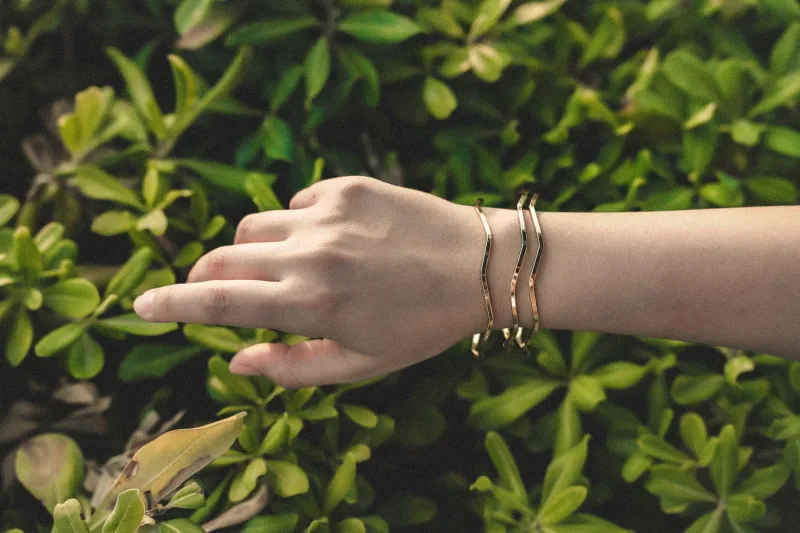
Consider the wardrobe stripped to its essentials: a precisely cut coat in camel or charcoal, a shirt in the quietest possible white, trousers that fall without drama. No excess. No decoration for its own sake. And then, at the wrist or the collarbone or the ear, a single piece of jade — saturated, ancient, wholly alive — that arrests attention and refuses to release it.
This is not an accident of styling. It is a philosophy, and it is one that is finding an increasingly devoted following among American luxury consumers who have grown weary of accumulation and are instead pursuing something rarer: genuine presence.
The Paradox at the Center
There is an apparent contradiction in wearing what is, by any measure, a maximalist object — a bangle of translucent imperial jadeite, say, or a carved nephrite pendant of considerable scale — within a wardrobe that has been otherwise rigorously edited. The stone is not subtle. It does not whisper. And yet the collectors and stylists who have embraced this approach argue that the contradiction is precisely the point.
"Minimalism is not about disappearing," observes one New York-based personal stylist whose clientele includes executives and collectors with significant jewelry holdings. "It is about directing attention with complete control. When everything else is removed, the stone does not compete with anything. It simply is."
This distinction — between competing for attention and commanding it — sits at the heart of what might be called the single-stone principle. In a room full of layered necklaces and stacked rings, the eye moves constantly, finding no place to rest. A single jade piece, worn against a background of deliberate quiet, creates a different experience entirely: one of sustained focus and, for those who know the stone, genuine contemplation.
Why Jade, Specifically
Many stones can anchor a minimalist outfit. What makes jade particularly suited to this role is a quality that gemologists describe in technical terms but that collectors tend to articulate more intuitively: the stone has interior life.
Fine jadeite — particularly material of imperial or near-imperial quality — does not simply reflect light. It absorbs it, distributes it, and releases it in a way that changes with the angle of viewing, the quality of the ambient light, and, some would argue, the mood of the wearer. A diamond announces itself immediately and completely. A fine jade reveals itself gradually, rewarding sustained attention in a way that suits the minimalist aesthetic precisely because it gives the observer something to return to.
Nephrite, with its silkier surface and more muted depth, offers a different but equally compelling proposition for the restrained wardrobe. Its colors — the deep spinach greens, the creamy whites, the warm browns of russet material — are organic rather than vivid, making it a natural complement to the neutral palettes that characterize contemporary luxury dressing in the United States.
The Tension with Maximalist Culture
The single-stone philosophy exists in deliberate dialogue with the dominant jewelry culture of the past decade, which has celebrated layering, mixing, and the kind of abundant self-expression that treats the body as a surface to be covered rather than framed. That culture has produced genuinely joyful results and has democratized personal adornment in meaningful ways. But it has also, for some consumers, produced a kind of visual fatigue.
The backlash — if it can be called that — is not a rejection of jewelry itself but a recalibration of what jewelry is asked to do. Among collectors who have spent years building significant holdings, there is a growing inclination to select one piece per occasion with the same deliberateness that a curator brings to hanging a gallery wall. The other pieces remain in their cases, not forgotten but resting — present in potential rather than in fact.
This approach requires a particular kind of confidence. Wearing a single stone is a declaration that the piece is sufficient, that the wearer's judgment is secure enough to need no reinforcement from additional adornment. It is, in that sense, a more exposed position than the layered alternative, and one that places considerable responsibility on the chosen piece to justify the trust placed in it.
Choosing the One
For those drawn to the single-stone approach, the question of selection becomes correspondingly serious. If a piece is to be worn alone, it must be genuinely worthy of solitude. This tends to accelerate the move toward investment-grade material — not because price is the criterion, but because the qualities that make a jade piece expensive (exceptional color saturation, fine texture, high translucency, skilled cutting) are also the qualities that sustain interest when the stone has no competitors for the eye's attention.
Styling considerations shift as well. The relationship between a single jade piece and the garments around it becomes more intimate and more demanding. Color temperature matters: an icy lavender jadeite reads differently against cream than against slate. Scale must be calibrated not to the other jewelry being worn — there is none — but to the proportions of the body and the visual weight of the clothing itself.
Many collectors who practice the single-stone approach describe developing a small number of signature pieces that rotate through their wardrobe rather than accumulating endlessly. A carved nephrite bangle for structured daywear. A jadeite pendant of exceptional color for evening. Perhaps a pair of carved earrings for occasions that call for something more delicate. The collection is curated rather than comprehensive, and each piece earns its place by being genuinely irreplaceable.
The Deeper Resonance
Jade has always carried meaning beyond adornment. In the traditions that have shaped its cultural significance — Chinese, Mesoamerican, Māori, and others — the stone has been understood as a mediator between the human and the enduring, between the personal and the cosmic. Wearing it alone, without distraction, is in some sense a return to that original seriousness.
For the contemporary American minimalist, this resonance may be intuited rather than consciously articulated. But it is present nonetheless. The choice to let a single stone speak — to trust it completely, to give it the silence it needs to be heard — is, at its deepest level, a statement about what one believes jewelry is for.