Breaking the Chain: How a New Generation of Collectors Is Rewriting the Rules of Jade Inheritance
For generations, fine jade passed through families the way real property does: with gravity, with expectation, and with an unspoken understanding that the recipient would steward what came before. A grandmother's imperial green bangle. A grandfather's carved pendant acquired in Hong Kong in the 1970s. These were not merely objects. They were arguments about identity, continuity, and belonging.
But something has shifted. Across America's most affluent households, a quiet and consequential rupture is underway. Younger collectors with the financial means—and in many cases the genuine aesthetic appreciation—to receive extraordinary jade pieces are choosing, with increasing frequency, to begin again. To build their own collections. To define their own relationship with the stone, independent of what came before them.
This is not a story about ingratitude. It is a story about identity, market forces, and the evolving meaning of luxury itself.
The Weight of Someone Else's Taste
Amelia Cortland, thirty-four, is a private equity associate in Chicago who grew up watching her mother wear a flawless lavender jadeite ring—a piece her family acquired through a Hong Kong dealer in the late 1980s and appraised most recently at a figure well into six digits. When her mother offered it to her two years ago, Amelia declined.
"It's a magnificent stone," she says. "But it was never mine. I would have been wearing my mother's story, not my own. And I think at this point in my life, I want to build something that reflects who I actually am."
What Amelia chose instead was a custom-cut black jadeite piece from a contemporary American atelier—darker, more architectural, and entirely her own. She has since acquired three additional pieces, each selected with the counsel of a private gemologist she retains independently.
This pattern—declining inheritance in favor of independent acquisition—is something that estate specialists and auction house advisors are beginning to track with genuine attention. "We are seeing it with increasing regularity," says one senior specialist at a major East Coast estate advisory firm, who asked not to be named given client confidentiality obligations. "The younger generation often expresses deep respect for a family piece while simultaneously having no desire to own it. That's a new kind of collector psychology."
What the Market Reveals
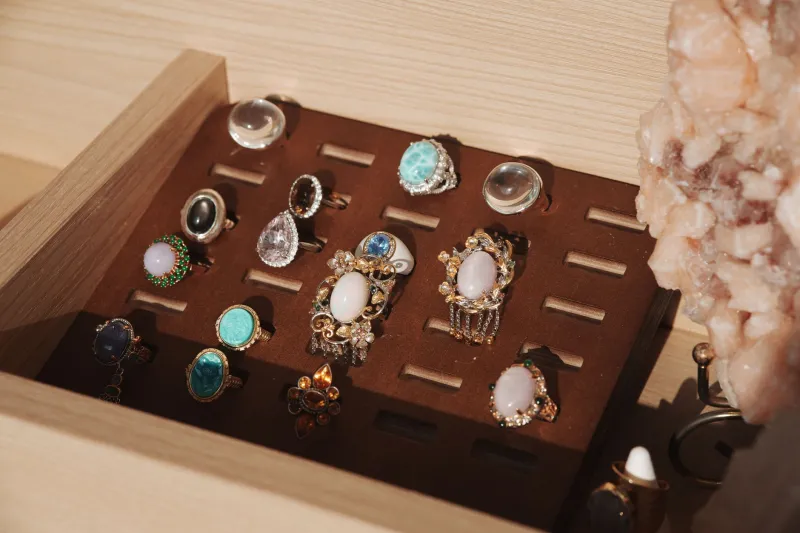
The commercial signal is unmistakable. Demand for contemporary jade designs—pieces that depart from the traditional forms of carved pendants, archaic-style bangles, and cabochon rings set in yellow gold—has grown substantially among buyers under forty. Dealers report increased interest in alternative color palettes: the deep spinach greens, the dusky lavenders, the near-black tones that read less as heirlooms and more as statements.
Auction data from the past three years reflects a similar pattern. Lots described as "family collection" or "estate provenance" continue to command strong prices—but increasingly from buyers in their fifties and older. Younger bidders, when they appear at auction at all, tend to pursue pieces with documented contemporary provenance: works by named contemporary carvers, pieces with traceable acquisition histories that begin within the last two decades.
Market analysts who track the fine jade segment suggest that this generational divergence is not purely aesthetic. "There is a values dimension to it," notes one analyst who advises family offices on collectible asset allocation. "Younger affluent consumers are more likely to want to understand the supply chain behind a piece. They want ethical sourcing documentation. They want to know the carver's name. A family heirloom, however beautiful, comes with a provenance story that was written under different standards—and that matters to this cohort."
The Question of Financial Logic
For collectors who approach jade as a component of a broader wealth strategy, the decision to decline inheritance raises an immediate financial question: is it rational to forgo a piece of established value in order to build from scratch?
The answer, perhaps surprisingly, is sometimes yes.
Inherited pieces carry their own complications. Condition issues that accumulated over decades of wear. Settings that reflect the aesthetic conventions of another era and require costly modification. Appraisal records that may be outdated, incomplete, or issued by institutions whose standards have since evolved. And in some cases, the emotional complexity of ownership—knowing that a piece belonged to someone else, that it carries associations that may not always be welcome—can suppress the enjoyment that fine jade is meant to provide.
"The best investment in jade is one you will actually wear and engage with," says a gemologist based in New York who works with collectors across the country. "A piece that sits in a drawer because it feels like an obligation is not performing any function—financial or personal."
Building a collection from the ground up also allows younger collectors to apply contemporary due diligence standards from the outset: current laboratory certifications, documented sourcing, relationships with vetted dealers and carvers. The collection they build may not start with the same monetary value as what they declined, but it begins on a foundation of complete transparency.
A New Kind of Legacy
There is something worth acknowledging in the apparent paradox here. The generation that is most vocally interested in legacy—in sustainability, in authenticity, in the long view of material culture—is also the generation most likely to sever the direct line of jade inheritance. But perhaps this is not a contradiction at all.
For many younger collectors, building independently is itself an act of legacy-making. They are not rejecting the idea of passing something meaningful forward. They are insisting that what they pass forward be genuinely theirs.
Sophia Reyes, twenty-eight, a second-generation Mexican-American entrepreneur based in Los Angeles, has begun acquiring jade pieces with deliberate intentionality—each one chosen to represent a specific chapter of her adult life. "My children will inherit stones that I chose, that I wore, that mean something specific about who I was," she says. "That feels more honest to me than inheriting someone else's choices and passing them on as if they were mine."
The jade market, for its part, is adapting. Contemporary ateliers report that younger clients frequently request documentation packages—provenance letters, carver biographies, sourcing statements—that were rarely requested a decade ago. These collectors are building archives alongside their collections, ensuring that when the time comes to pass their jade forward, the story will be complete.
The chain has not broken. It has simply been reforged—link by deliberate link, by collectors who understand that the most enduring legacy is one built with intention.